

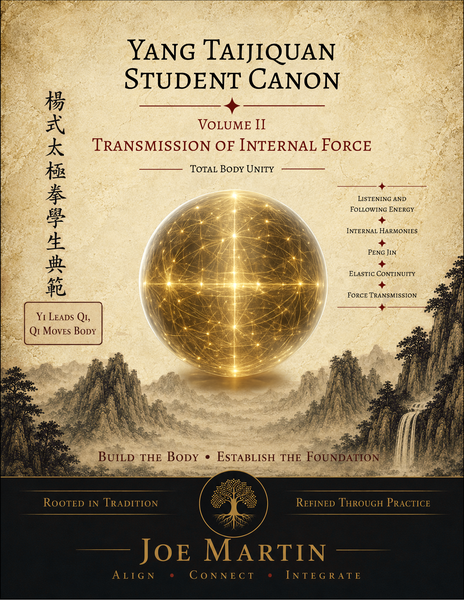
YANG TAIJIQUAN STUDENT CANON · VOLUME II
Transmission of Internal Force
From Internal Conditions to Functional Relationships
Volume I established the structural and internal conditions of the Taiji body. Volume II examines what happens when those conditions begin functioning together.
Listening, following, neutralizing, spiraling, harmonizing, and issuing are developed as interconnected expressions of internal continuity rather than isolated techniques.
A Study of Relationships
A well-aligned body is not yet an integrated body. The conditions established in Volume I must learn to cooperate. Root cannot function independently of the kua. The kua cannot function independently of the center. The center cannot organize movement if continuity is lost elsewhere in the structure.
Volume II therefore does not approach internal skill as a collection of techniques. It studies the relationships that allow the body to behave as one continuous system.
The deeper lesson of internal training is that nothing acts alone.
From Contact to Understanding
Volume II begins with Stick, Adhere, Connect, Follow, then develops Ting Jin, Suijin, and Huajin. The order is deliberate. The student first learns to preserve a meaningful relationship with changing force.
Contact becomes information. Through Ting Jin, pressure, direction, timing, and intention become increasingly perceptible. Through Suijin, perception begins guiding movement so that the practitioner can remain adapted to what is occurring without unnecessary resistance. From this relationship, the conditions for genuine neutralization begin to emerge.
Continuity → Sensitivity → Organized Relationship → Adaptation
Continuity Before Power
As integration develops, force ceases to originate from isolated regions of the body. The practitioner gradually discovers that power does not depend upon increasing effort. It depends upon maintaining continuity.
That continuity must survive changes in direction, pressure, load, speed, and relationship. The primary and corner energies, spiraling, the Six Internal Harmonies, central equilibrium, rooting, the kua, dantian, spine, structural gateways, wrists, the Three Springs, fascia, and whole-body elasticity become parts of this larger problem.
Continuity is not one skill among many. It is the condition that allows the many to function as one.
Force as Transmission Rather Than Exertion
When the body is fragmented, force becomes local. A shoulder pushes. An arm reaches. A leg drives. One region works while another compensates.
Volume II develops a different possibility. Force is received, conducted, transformed, stored, and expressed through an organized structure without dependence upon local muscular effort.
The whole body participates in the transmission.
The Traditional Energies Become Functional
Peng, Lu, Ji, An, Cai, Lie, Zhou, and Kao are not presented merely as names attached to movements. They become a vocabulary through which the student learns to recognize functional relationships of force.
The purpose is to become literate in the behavior of force.
Read from Volume II
Stick, Adhere, Connect, Follow
Ting Jin: Listening Energy as Somatic Intelligence
Elastic Continuity and Force Transmission — Continuity Before Power
From Transmission to Transformation
Volume II forms the bridge between foundation and transformation. The individual conditions established in Volume I begin functioning together. Separate skills merge into unified behavior, and the body increasingly organizes itself as a single continuous system.
Volume III — Transformation of Internal Skill
Publication Details
Yang Taijiquan Student Canon Volume II: Transmission of Internal Force Author: Joe Martin Publisher: ESOMA Press First Edition: 2026 Format: Paperback ISBN: To Be Added Printed in the United States of America